My short verdict: the Canon EOS R100 is the easier camera to carry for a long walk, while the Rebel T7 remains a capable, inexpensive DSLR for learning and slower work. I have made photographs with both. The better choice is not “mirrorless always wins” or “the old camera is just as good.” It depends on weight, lens options, autofocus needs, and whether you already own one system.
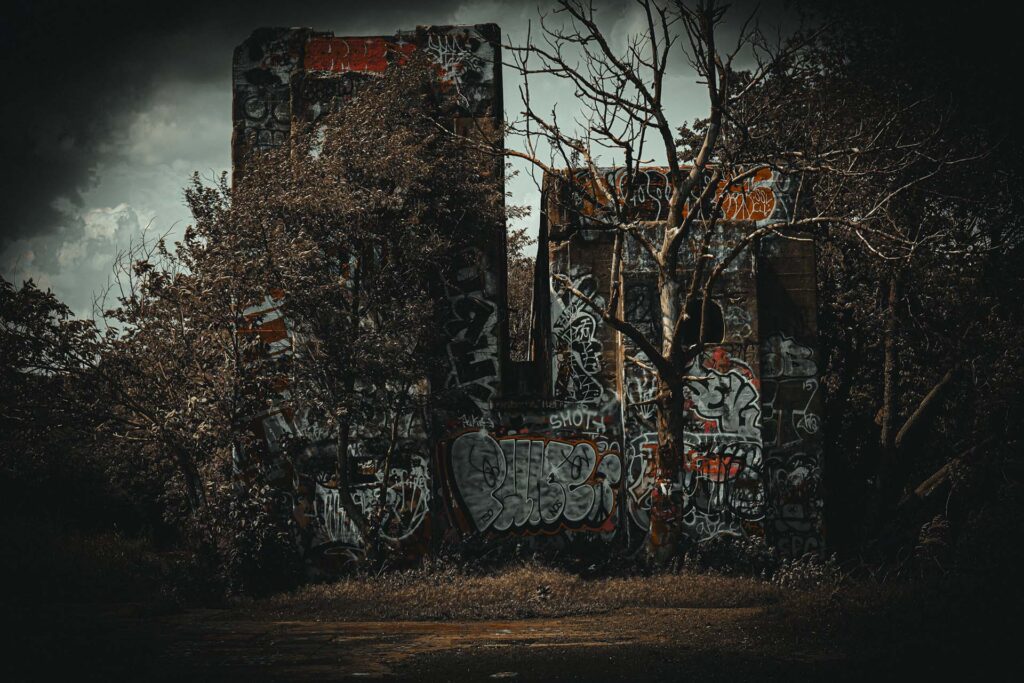
The comparison below separates Canon’s specifications from my field evidence. My R100 example comes from a May 2025 visit to Graffiti Pier in Philadelphia. The T7 example is a June 2021 roadside-light photograph near Ithaca, New York. They are different scenes, so they do not prove a controlled image-quality winner. They do show that both cameras have been part of my actual work.
Canon Rebel T7 vs. EOS R100 at a Glance
| Difference | Rebel T7 | EOS R100 | What it means outdoors |
|---|---|---|---|
| Camera type | DSLR, EF/EF-S mount | Mirrorless, RF/RF-S mount | The R100 body is smaller; existing lenses may decide the system. |
| Sensor | Approximately 24-megapixel APS-C | 24.1-megapixel APS-C | Resolution alone is not a useful reason to switch. |
| Body with battery and card | About 475 g | About 356 g | The R100 saves roughly 119 g before lenses. |
| Viewfinder | Optical | Electronic | The T7 shows the scene directly; the R100 previews exposure more clearly. |
| Continuous shooting | Up to about 3 fps | Faster modes available, depending on settings | The R100 is the more flexible choice for changing subjects, but neither is a sports flagship. |
The current figures come from Canon’s official Rebel T7 support page and EOS R100 support page. Canon lists the T7 at approximately 475 grams and the R100 at approximately 356 grams with battery and card. That difference is noticeable, but the lens and bag can erase it quickly.
Where the R100 Helped Me
At Graffiti Pier, the R100 was small enough to keep accessible while I worked around repeating columns, bright paint, and deep shade. The photograph above was made at 35 mm, f/8, ISO 100, and 1/250 second. Those settings gave me enough depth through the structure while keeping the handheld frame steady.
The electronic viewfinder is useful when light changes quickly between open sky and covered concrete. It does not make the composition for me, but it reduces the gap between the exposure I expect and the file I bring home. The lighter body also matters when photography is only one part of a walking day.
The R100 has real limits. Canon’s own specifications show no touchscreen operation, no in-body stabilization, and contrast-detection autofocus during 4K recording. It is a straightforward entry-level camera, not a miniature version of Canon’s higher-end bodies.
Why the Rebel T7 Still Has Value

The T7 photograph is quieter: roadside plants held against warm evening light near Ithaca. It was made at 29 mm, f/5.6, ISO 100, and 1/50 second. The camera did not need a fast burst or advanced subject detection. It needed a clean silhouette, a steady hold, and someone willing to notice the smaller scene after the obvious photograph was finished.
The optical viewfinder and simple controls make the T7 a direct teaching camera. Its three-frame-per-second maximum and older autofocus system are clear limitations for fast action. For landscapes, travel details, and deliberate compositions, those limits do not erase the camera’s usefulness.
Which One Would I Carry?
- Long walking day: R100, especially with one small RF-S lens.
- Learning with a T7 already in hand: keep the T7 and spend time making photographs before spending money.
- Existing EF/EF-S lens collection: price the adapter and complete kit before assuming the R100 is cheaper or lighter.
- Moving people or subjects: R100 for the newer autofocus system and faster shooting options.
- Wet waterfall trail: neither body replaces a secure carry system, lens cloth, weather protection, and good footing.
I would not buy either camera from a table alone. Handle the controls, account for the lens, and decide what you will actually carry. For my field use, the R100 is the practical lightweight choice. The T7 is still a good reminder that an older camera can make a meaningful image when the scene does not require features it lacks.
Sources & Field Notes
- Canon EOS R100 field photograph: May 17, 2025; 35 mm; 1/250 second; f/8; ISO 100.
- Canon Rebel T7 field photograph: June 23, 2021; 29 mm; 1/50 second; f/5.6; ISO 100.
- Canon EOS R100 official support and specifications.
- Canon Rebel T7 official support and specifications.
For the trail rather than the body, read my waterfall hike camera-kit guide or browse my photography work.
The Falls Here Network
Explore more regional outdoor stories.
Regional outdoor stories, waterfalls, food stops, photography, and travel notes across PA, NJ, NY, DC, MD, VA, and Philadelphia.