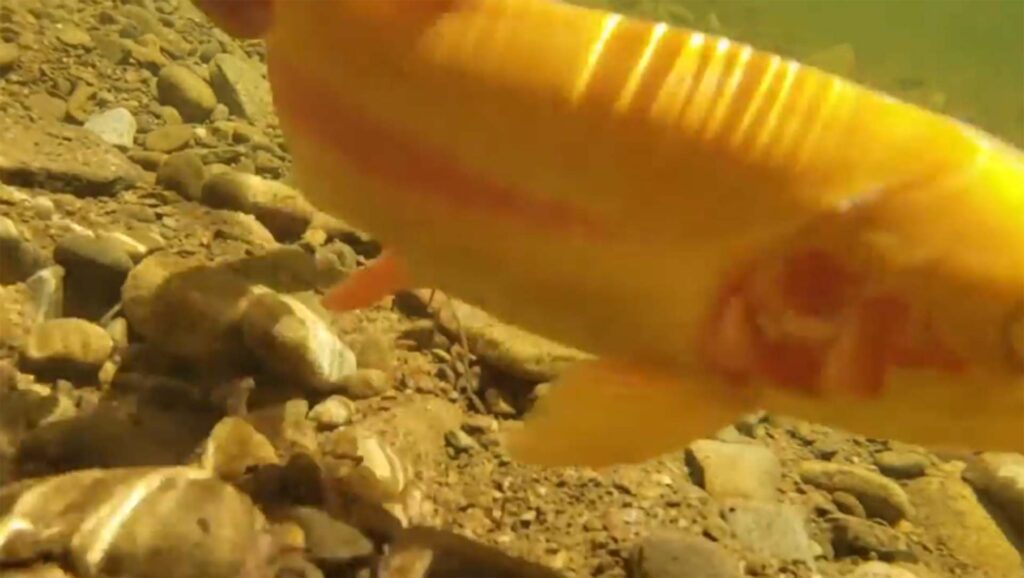
The fish was impossible to miss. Against the darker stones and green-brown water of Loyalsock Creek, it moved like a strip of sunlight—bright gold, almost orange, and far more visible than the trout around it. In Pennsylvania, many of us grew up calling a fish like this a palomino trout. The more precise current name is golden rainbow trout.
I photographed this one during a visit to the Worlds End area of Sullivan County. This is not a secret-fishing-spot report or a promise that the same fish will be waiting in the same pool. It is a field story about noticing one unusual detail in a landscape that already gives a photographer plenty to work with.
A Golden Rainbow Trout, Not a Separate Wild Species
The Pennsylvania Fish and Boat Commission identifies golden rainbow trout as Oncorhynchus mykiss, the same species as a rainbow trout. Pennsylvania’s fish reference explains that the golden-orange strain was developed through hatchery breeding and has a long history of stocking in the Commonwealth. The familiar “palomino” name remains common, but the state’s current stocking program calls them golden rainbow trout.
That distinction matters. The color is remarkable, but it does not make the fish a mysterious native species. According to the Commission’s 2026 stocking announcement, approximately 18,000 golden rainbow trout were scheduled for stocking statewide. Anglers should use the current Commission schedules and regulations rather than treating an old photograph—or any blog post—as a stocking report.
Why the Loyalsock Setting Holds My Attention
Worlds End State Park sits in a narrow, S-shaped valley along Loyalsock Creek, just south of Forksville. The park is surrounded by Loyalsock State Forest, and that combination of steep forest, rock, moving water, and changing light gives the place its character. The official DCNR park page is the right starting point for current maps, contacts, and visit information.
The creek is only one part of the visual story. Hemlock shade can make the water feel cool and dark even in the middle of the day. Open patches catch reflections from the sky. Rocks interrupt the current and create small bands of texture. When a bright fish enters that scene, the job is not simply to point the camera at the orange shape. The challenge is to show the fish as part of the water without losing it in glare or turning the whole frame into a flat wildlife record.
What Made the Photograph Difficult
Photographing into moving water creates several problems at once. The surface reflects the sky and surrounding trees. The fish changes direction. Refraction makes its apparent position deceptive. If the shutter is too slow, the fish becomes a soft streak. If it is too fast and the light is weak, image quality can fall apart as the camera raises ISO.
I no longer have dependable EXIF notes for this frame, so I am not going to invent a shutter speed or lens setting years later. What the image still documents clearly is the field problem: a bright subject beneath a reflective, moving surface. On a return visit, I would begin with a shutter fast enough to hold the fish’s movement, then adjust ISO and aperture around the available light. I would check the histogram for clipped highlights on the fish instead of trusting the rear-screen preview alone.
A polarizer can help, but it changes the frame
A circular polarizer can reduce surface glare and reveal more detail below the water, but it also removes light and can erase reflections that give the creek depth. I prefer to rotate it while watching the scene rather than automatically turning it to maximum effect. Sometimes a little reflection makes the better photograph.
Position matters more than chasing the fish
The safer and more respectful approach is to choose a stable position and wait. Moving along a slick bank while staring through a viewfinder is a good way to fall, disturb the water, or pressure the fish. I would rather miss a frame than enter the stream carelessly or crowd an animal for a closer photograph.
Planning a Responsible Worlds End Visit
Conditions in the Loyalsock watershed change with rain, season, and water level. Check DCNR’s current park information before leaving, use established access, and treat wet rock as slippery. The park’s trail system ranges from short walks to difficult climbs; the official Worlds End hiking guide lists distance and difficulty rather than leaving visitors to guess from a social post.
If fishing is the purpose of the trip, consult the Pennsylvania Fish and Boat Commission for current licensing, seasons, stocking information, and regulations. If photography is the purpose, the same basic ethic applies: avoid trampling stream banks, do not move natural objects to improve a composition, keep wildlife wild, and carry out what you carry in. The Leave No Trace principles are a useful baseline for any creek or trail day.
The Photograph I Would Make Next
I would still make the close frame, but I would also step back. A second photograph showing the fish as a small flash of color within the larger creek would say more about the encounter. That is the image I remember: not an isolated specimen, but a sudden bright detail inside a shaded Pennsylvania valley.
That slower way of looking connects this story to my Ricketts Glen field notes and the broader Falls Here journey. The best outdoor photographs rarely begin with a checklist. They begin when something small makes me stop walking.
Sources & Field Notes
- Pennsylvania DCNR: Worlds End State Park
- Pennsylvania DCNR: Loyalsock State Forest
- Pennsylvania Fish and Boat Commission: Trout
- Pennsylvania Fish and Boat Commission: 2026 stocking announcement
- Field evidence: Jasper DiSanto photograph and video from the Worlds End/Loyalsock visit. Exact capture settings were not preserved, so none are claimed.
If you need natural, place-aware photography for a Pennsylvania property, outdoor brand, or regional story, start with my photography work.
The Falls Here Network
Explore more regional outdoor stories.
Regional outdoor stories, waterfalls, food stops, photography, and travel notes across PA, NJ, NY, DC, MD, VA, and Philadelphia.